
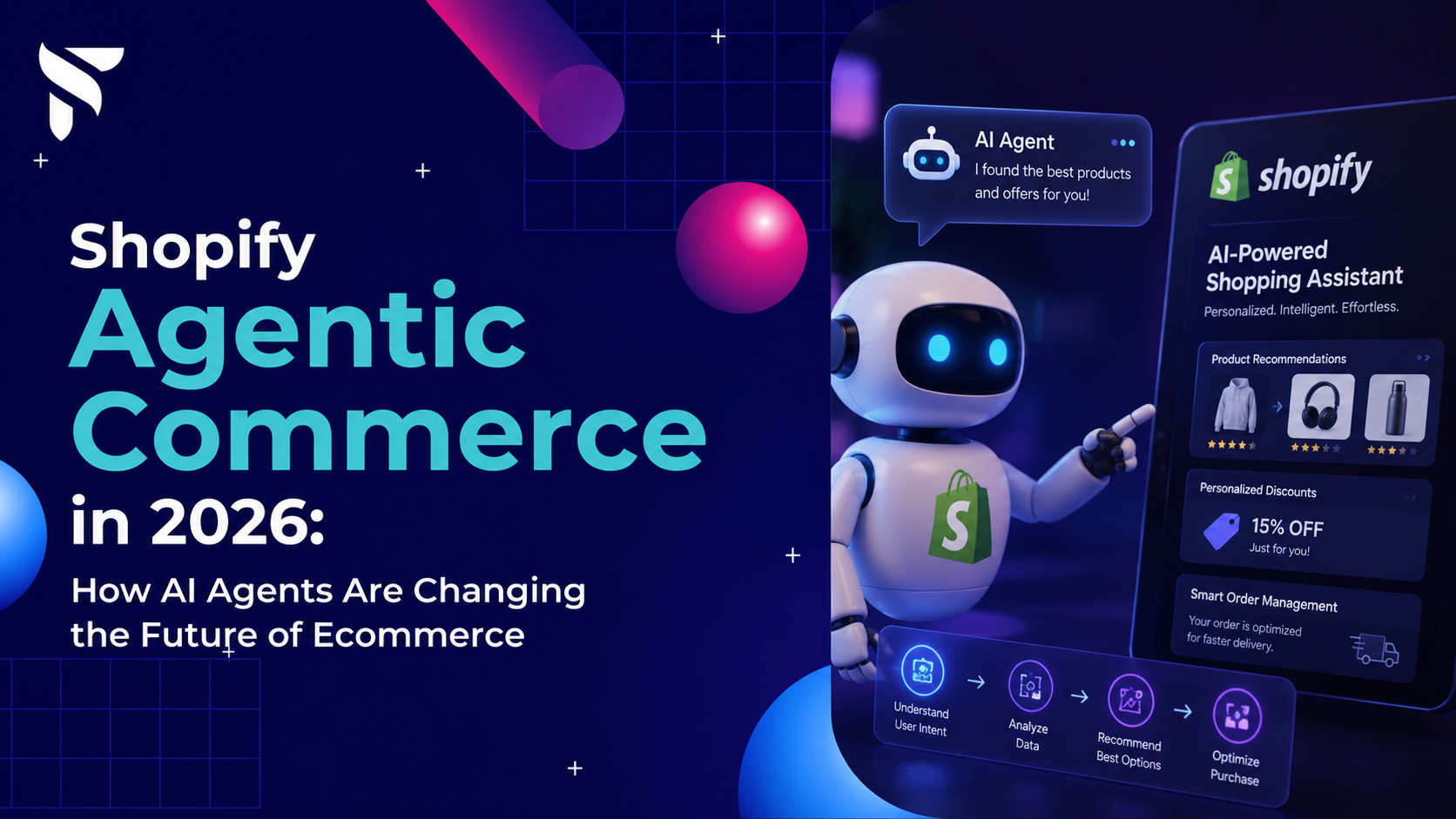
Shopify agentic commerce is Shopify’s emerging infrastructure for a world where software agents, not only human shoppers browsing storefronts, can discover products and participate in commerce workflows.
That shift became much more concrete in 2026. Shopify’s Spring ’26 Edition opened its agentic-commerce infrastructure more broadly to developers, combining Shopify Catalog for product discovery with Universal Commerce Protocol (UCP) infrastructure for commerce interactions spanning carts, checkout and orders.
The result is not an autonomous AI shopper with unlimited authority to spend a customer’s money. The reality is more nuanced and more technically interesting: AI systems can increasingly interpret buying intent, search structured commerce data, compare products, assemble carts and initiate checkout, while authentication, payment authorization and merchant rules determine how far automation can go.
For Shopify merchants and ecommerce developers, that creates a new question:
What happens when your next storefront is an AI conversation, and the software evaluating your product is an agent rather than a person scrolling a collection page?
What Is Shopify Agentic Commerce?
Agentic commerce is ecommerce in which AI agents can perform multiple steps of the shopping process on behalf of a user rather than merely answering questions.
Consider conventional ecommerce:
Customer → Storefront → Search → Product page → Comparison → Cart → Checkout → Fulfillment
The customer performs most decisions and actions.
Agent-mediated commerce can look more like:
Customer intent → AI agent → Product discovery → Comparison → Cart/checkout preparation → Customer authorization → Transaction → Merchant fulfillment
The customer still owns the intent and, depending on the implementation, the final purchasing authority. But software can handle much more of the work between those points.
A customer might tell an assistant:
Find me a waterproof carry-on backpack under $150 that fits a 16-inch laptop and can arrive before Friday.
Instead of returning generic links, an agent connected to commerce infrastructure could translate that request into constraints, search structured product catalogs, evaluate eligible products, retrieve current prices and availability, assemble suitable options and move the buyer toward checkout.
That distinction separates agentic commerce from many earlier forms of ecommerce AI.
Agentic commerce vs. conversational commerce
A chatbot can answer, “What is your return policy?”
A recommendation engine can calculate, “Customers who bought this also bought…”
A conversational shopping assistant can understand, “Show me running shoes under $120.”
An agentic commerce system can potentially combine discovery with actions: search commerce systems, inspect products, maintain a cart, initiate checkout and, when appropriate authorization exists, execute permitted transaction-related operations.
The difference is agency plus access to tools.
An AI model does not become a commerce agent merely because it can discuss products. It needs machine-readable access to commerce capabilities and permission to act on them.
Why Shopify Agentic Commerce Matters in 2026
Shopify Agentic Commerce matters in 2026 because Shopify is extending commerce beyond the traditional online-store interface. Product discovery, cart operations and checkout capabilities can increasingly be exposed to AI systems through structured commerce infrastructure.
Shopify’s strategy did not begin with Spring ’26.
In December 2025, Shopify introduced Agentic Storefronts as infrastructure for making merchant products available through AI shopping surfaces.
On January 11, 2026, Shopify and Google announced the Universal Commerce Protocol, an open commerce standard designed to give AI platforms and businesses a common way to interact.
By March 2026, Shopify said millions of merchants could sell to ChatGPT users through Agentic Storefronts, while its Agentic plan extended Shopify Catalog and agentic channels to eligible businesses whose primary ecommerce platform was not Shopify.
Then came Spring ’26 on June 17, 2026.
Shopify opened the developer side of this infrastructure substantially. Developers no longer need the previous approval process to start building against Shopify’s agentic-commerce layer. Current Shopify documentation provides catalog, cart, checkout and order capabilities designed for AI-agent workflows.
This matters because Shopify is no longer treating the storefront as the only meaningful interface to a merchant’s commerce system.
A store remains important. But Shopify is also positioning product data and commerce operations as infrastructure that other interfaces can use.
Those interfaces could be ChatGPT, Gemini, Microsoft Copilot, Shop or applications built by independent developers.
The $3–5 trillion forecast, correctly explained
One market figure deserves correction because it is easy to misattribute.
The estimate that agentic commerce could reach $3 trillion to $5 trillion globally by 2030 is McKinsey research, not a Shopify forecast.
McKinsey estimates that agentic commerce could orchestrate roughly $900 billion to $1 trillion of US B2C retail revenue by 2030, with the global opportunity reaching $3 trillion to $5 trillion.
That does not mean AI companies will generate $5 trillion in revenue.
It refers to consumer commerce that could be mediated or orchestrated by AI agents. McKinsey says the estimate covers goods and does not include services or the B2B opportunity. It is a forecast based on assumptions about adoption and merchant readiness, not a measurement of guaranteed future spending.
How Agentic Shopping Actually Works
Return to the backpack request:
Find me a waterproof carry-on backpack under $150 that fits a 16-inch laptop and can arrive before Friday.
A mature agentic shopping experience could process that request in several stages.
1. Interpret the customer’s intent
The agent extracts constraints:
- Product: carry-on backpack
- Maximum price: $150
- Requirement: waterproof
- Laptop compatibility: 16 inches
- Delivery deadline: before Friday
It can also use contextual information that the customer has explicitly made available, such as shipping country or account information.
2. Discover eligible products
Instead of relying only on crawling webpages, an agent can query structured commerce data.
Shopify’s Global Catalog gives agents a way to search products across eligible Shopify merchants, while Storefront Catalog can scope discovery to a single merchant.
This distinction matters.
A crawler tries to infer commerce information from webpages designed primarily for humans. A commerce catalog exposes product information in structures designed to be queried programmatically.
3. Retrieve and compare product information
The agent can evaluate the information available for candidate products.
Depending on the catalog data and interface, this can include attributes such as:
- title
- description
- price
- availability
- variants
- size
- color
- images
- merchant information
- delivery-related context
Not every desired property will necessarily exist or be equally reliable. Shopify’s own Catalog documentation warns that some fields can be inferred using AI and may vary in availability or accuracy.
That is why catalog quality matters.
If one backpack is described only as “Premium Travel Backpack” while another has explicit dimensions, material, laptop capacity and product category information, the second product gives an agent more evidence to evaluate against a constrained request.
4. Build a cart
Once the buyer selects a product, an agent can use commerce tools to create and modify a cart.
Shopify’s Cart MCP implementation supports a pre-checkout container containing line items, localization context and optional buyer information. This lets an agent calculate and refine a purchase before starting the more sensitive checkout process.
5. Initiate checkout
When the customer is ready, the cart can be converted into a checkout session.
At this point, requirements become stricter.
Shopify distinguishes exploratory cart operations from checkout operations, and authentication and trust levels determine which capabilities an agent receives.
6. Obtain authorization or hand off
This is where the popular idea of an autonomous shopping bot needs qualification.
AI agents cannot simply spend a customer’s money whenever they decide a product looks suitable.
Current UCP documentation states that checkout ordinarily must be finalized manually by the user through a trusted interface unless the required delegated-payment mechanism is supported.
Shopify’s own implementation also distinguishes trust levels. Anonymous and signed agents can work with catalog, cart and checkout-building capabilities, but purchase completion requires stronger authorization.
7. Merchant processes the order
Once a legitimate purchase completes, the merchant remains responsible for commerce operations such as fulfillment, returns and customer service according to the merchant’s policies and platform configuration.
Shopify explicitly states that the merchant remains the merchant of record.
The AI interface does not automatically become the retailer simply because the shopping conversation happened there.
The Architecture Behind Shopify Agentic Commerce
The architecture behind Shopify Agentic Commerce separates the AI interface from the underlying commerce infrastructure. An external AI platform can manage the conversation and reasoning layer while Shopify provides catalog, cart, checkout and merchant-commerce capabilities.
Customer
   ↓
AI assistant / shopping agent
   ↓
Intent + constraints
   ↓
Shopify Catalog / product discovery
   ↓
Product candidates
   ↓
Agent comparison and recommendation
   ↓
Cart / UCP commerce capabilities
   ↓
Checkout + authentication + authorization
   ↓
Shopify merchant commerce system
   ↓
Order
   ↓
Merchant fulfillment / returns / support
The critical architectural point is that the AI model does not need to own the entire commerce stack.
An external AI platform can own the conversation and reasoning layer.
Shopify can provide catalog and commerce infrastructure.
The merchant controls the underlying product, pricing, inventory, policies and fulfillment.
Payment providers and identity systems can handle their respective responsibilities.
UCP exists partly to give those systems a common commerce language instead of requiring every agent and retailer to create a unique integration.
What Is Universal Commerce Protocol (UCP)?
The Universal Commerce Protocol, or UCP, is an open-source commerce standard designed for interactions between consumer surfaces, businesses and payment providers in agentic shopping experiences.
It was announced on January 11, 2026 and developed by Google in collaboration with Shopify and other commerce companies.
Calling UCP “Shopify’s protocol” is therefore inaccurate.
Shopify is an important co-developer and implementer, but UCP is intended as broader interoperable infrastructure.
Why UCP exists
Without a common protocol, imagine 1,000 shopping agents attempting to integrate with 1,000 commerce systems.
Each combination could require custom assumptions about products, carts, checkout, payments, identity and order handling.
Protocols reduce that integration problem by defining common capabilities and data structures.
The web itself works on this principle. Browsers and servers do not need to be built by the same company because they agree on standards for communication.
UCP attempts to bring a similar principle to AI-mediated commerce.
UCP architecture and interoperability
Google describes UCP as providing a common language and functional primitives for commerce.
The protocol is designed to work with existing retail infrastructure and supports integration through mechanisms including APIs, Model Context Protocol and Agent-to-Agent interfaces.
A business can expose supported services and capabilities through its UCP profile. An agent can discover those capabilities rather than assuming every merchant supports the same operations.
That is an important detail.
Interoperability does not mean every merchant exposes every feature.
It means participants can communicate through agreed structures while negotiating which capabilities are actually supported.
Commerce functions can include areas such as discovery, cart operations, checkout, fulfillment and related extensions.
Authentication, authorization and checkout
Commerce agents introduce a problem ordinary product search does not:
Who gave this software permission to act?
Shopify’s agent infrastructure therefore uses different trust levels.
Anonymous agents can access less-sensitive capabilities at lower rate limits. Signed agents can identify themselves cryptographically. Token-authenticated agents can receive broader access, and buyer-linked tokens can associate permitted requests with a signed-in shopper.
Higher trust does not mean unlimited authority.
Shopify documents permission requirements around operations such as checkout completion, while UCP’s checkout specification establishes a human-finalization boundary unless supported delegated authority exists.
That separation between what an agent technically can call and what a buyer has authorized it to do is fundamental to safe agentic commerce.
What Is Shopify Catalog API?
Shopify Catalog is therefore a core discovery layer in the broader Shopify Agentic Commerce architecture, helping agents retrieve structured product information instead of relying entirely on conventional webpage interpretation.
If UCP provides commerce interaction infrastructure, Shopify Catalog addresses the discovery problem.
Shopify describes Catalog as structured product infrastructure spanning eligible products from its merchant ecosystem.
For AI systems, that is valuable because product discovery becomes less dependent on extracting meaning from arbitrary webpages.
Global Catalog vs. Storefront Catalog
Shopify currently documents two catalog interfaces.
Global Catalog searches across eligible Shopify merchants.
Storefront Catalog searches products belonging to a particular merchant.
That enables very different applications.
A general shopping assistant could search broadly:
Find noise-canceling headphones under $100.
A merchant-specific assistant could instead search only one brand’s catalog:
Which of your headphones have the longest battery life?
Both are agentic product-discovery use cases, but their commercial context is different.
Why structured product data matters
Human shoppers can compensate for weak ecommerce data.
A person might inspect product photos, read several paragraphs, infer the material and open a shipping-policy page.
Agents work better when important product facts are explicit and machine-readable.
That increases the strategic importance of accurate:
- titles
- categories
- variants
- prices
- availability
- dimensions
- colors
- sizes
- materials
- product identifiers
- shipping information
- product descriptions
Shopify says Catalog continuously updates product information such as pricing and inventory across AI channels and structures merchant data so agents can parse it.
The implication for merchants is straightforward:
Product data is becoming part of the acquisition layer.
It is no longer only operational information used to render a product page.
Catalog API limitations
Structured data does not eliminate uncertainty.
Shopify warns developers not to cache Catalog search results because current merchant preferences, availability and pricing matter.
Catalog queries are rate limited.
Some fields may be AI-inferred rather than explicitly supplied by merchants.
Product eligibility also matters. Being a Shopify product does not automatically imply unrestricted distribution through every AI interface.
And discoverability does not guarantee recommendation.
Catalog access gives an agent the ability to find a product. The AI platform still determines which products are relevant enough to present.
Where Can Shopify Products Appear in AI Shopping?
One of the biggest mistakes in discussing agentic commerce is assuming every AI platform implements the same shopping journey.
They do not.
ChatGPT
Shopify products can be discovered through ChatGPT, but the current Shopify integration is primarily discovery-focused.
After finding a product, the customer completes the transaction using the merchant’s online-store checkout, surfaced through an in-app browser or browser handoff depending on the environment.
This is a significant change from the original direction announced in 2025, when OpenAI introduced Instant Checkout and said Shopify merchants would be included.
OpenAI has since said it is focusing on product discovery while allowing merchants to use their own checkout experiences.
For merchants, that means existing checkout customizations, payment methods, branding and selling strategies remain relevant to ChatGPT-referred purchases.
Microsoft Copilot
Microsoft and Shopify support a more embedded transaction experience through Copilot Checkout for eligible merchants.
The shopping conversation can move from intent toward transaction without requiring the conventional storefront browsing journey, while Shopify powers the merchant checkout infrastructure.
Google AI Mode and Gemini
Shopify has also integrated agentic shopping with Google AI Mode and Gemini.
As of July 2026, Shopify states that this integration remains early access and is not available to every Shopify store.
Eligible products are provided through the Google & YouTube sales channel, and supported experiences can provide Shopify-powered direct checkout within the AI environment.
Shop
Shop itself functions as a Shopify-owned agentic storefront.
Its AI shopping functionality can use Shopify Catalog for conversational discovery while remaining connected to Shopify’s broader buyer and merchant ecosystem.
These differences show why “AI agents can buy Shopify products” is too broad to be useful.
The accurate answer is:
AI agents can participate in product discovery, cart and checkout workflows, but the exact purchasing capability depends on the agent, channel, merchant eligibility, authentication, customer authorization and checkout implementation.
What Agentic Commerce Changes for Shopify Merchants
For merchants, Shopify Agentic Commerce introduces another product-discovery surface alongside storefronts, search engines, marketplaces, social commerce and shopping feeds.
The strategic shift is not “websites disappear.”
It is that the storefront may no longer be the first interface evaluating a product.
A human customer may arrive after an AI system has already narrowed hundreds of possibilities to three.
That changes ecommerce optimization.
Product data becomes part of merchandising
Historically, merchants optimized product pages primarily for people and search engines.
Agent-mediated discovery adds another audience: software systems evaluating whether a product satisfies structured constraints.
Consider two products.
Product A
Premium travel backpack. Perfect for every adventure.
Product B
35L waterproof carry-on backpack with padded 16-inch laptop compartment, 53 × 34 × 20 cm dimensions and water-resistant recycled nylon shell.
The second description supplies more decision-useful information.
This does not mean merchants should turn descriptions into databases.
It means important attributes should not be hidden behind vague marketing language.
SEO does not disappear
Agentic commerce is not evidence that ecommerce SEO is dead.
AI platforms can obtain product information through multiple mechanisms, including structured integrations, merchant feeds, crawling and indexing.
Search engines remain discovery systems. Product pages remain authoritative merchant resources. Informational content can establish product context, expertise and demand. Category architecture still helps humans and machines understand inventory.
The more reasonable strategy is to expand from SEO alone to multi-interface discoverability.
A merchant should be understandable to:
- shoppers
- search engines
- shopping platforms
- AI assistants
- structured commerce systems
The fundamentals of clear information become more important, not less.
Brand differentiation still matters
An agent can compare price and specifications quickly.
That makes products differentiated only by easily comparable attributes vulnerable to commoditization.
Brands need evidence for why a product should be selected.
That may include:
- distinctive product capabilities
- credible reviews
- warranties
- fulfillment quality
- return policies
- product expertise
- provenance
- customer service
- brand reputation
Agentic commerce can reduce browsing friction. It does not eliminate customer preferences.
Customer relationships still matter
Shopify’s architecture is deliberately designed to preserve merchant involvement in the transaction.
The merchant remains merchant of record, and in channels such as ChatGPT the buyer completes the purchase through the merchant’s checkout.
That is strategically different from a marketplace model where the marketplace owns most of the buying experience and customer relationship.
Whether that balance remains consistent across future agentic channels is something merchants should monitor.
Attribution and analytics change
Traditional ecommerce attribution often starts with a click:
Search → product page → cart → order.
Agentic journeys may start elsewhere:
Conversation → catalog search → AI recommendation → checkout → order.
Merchants therefore need visibility into questions such as:
- Which AI channels surface products?
- Which queries generate visibility?
- Which products receive referrals?
- Which AI channels produce orders?
- How do AI-referred shoppers convert?
- Which transactions use direct checkout versus merchant checkout?
Shopify has already added Agentic Storefront reporting to its admin, but measurement standards across the broader ecosystem are still developing.
What Agentic Commerce Means for Shopify Developers
For developers, Shopify Agentic Commerce creates opportunities beyond embedding another chatbot into an online store. Catalog and commerce interfaces make it possible to build AI experiences in which Shopify operates as underlying commerce infrastructure.
Spring ’26 creates opportunities beyond adding chatbots to stores.
Developers can increasingly treat Shopify as commerce infrastructure behind entirely different experiences.
Potential applications include:
Vertical shopping agents. Build an agent specialized in furniture, fashion, electronics, gifts or another category.
Contextual commerce applications. Recommend purchasable products while someone plans a trip, designs a room, prepares a recipe or organizes an event.
Catalog optimization software. Help merchants identify missing or ambiguous attributes that reduce machine discoverability.
Agentic analytics. Measure product visibility, recommendation frequency, referrals and conversion across AI surfaces.
Merchant automation. Keep catalog information, inventory and other commerce state synchronized with agent-facing systems.
Post-purchase agents. With appropriate authorization, provide order tracking and assist with workflows around fulfillment, returns or exchanges.
Shopify’s Spring ’26 demos illustrate this broader idea: commerce can become a capability embedded inside an application rather than requiring the application itself to become a conventional ecommerce storefront.
The opportunity is real, but developers should not confuse open access with unlimited access.
Authentication, rate limits, merchant eligibility, buyer permissions and channel-specific rules still apply.
Risks and Limitations of AI Agent Commerce
Agentic commerce removes friction, but friction sometimes exists for a reason.
Purchasing combines money, identity, preferences, contractual terms and fulfillment commitments. Delegating parts of that process creates meaningful risks.
Incorrect recommendations
Language models can misinterpret requests or produce unsupported claims.
Structured commerce data reduces some uncertainty but does not eliminate reasoning errors.
Agents should distinguish retrieved product facts from generated interpretation.
Stale or incomplete product data
An agent recommending a product using yesterday’s price or inventory can create a poor experience.
Real-time or near-real-time commerce data is therefore more important than static product knowledge.
Customer authorization
There is a large difference between:
Find the best option.
and:
Buy the best option.
A safe commerce architecture must know which authority the customer actually delegated.
Current UCP and Shopify architecture recognizes that distinction rather than assuming recommendation implies purchasing permission.
Privacy and identity
Personalized shopping can require information about a buyer’s identity, location, purchase history or preferences.
Systems need appropriate authentication and permissions before using or sharing that context.
Fraud
Traditional fraud systems often evaluate signals generated by human checkout behavior.
Agent-mediated transactions can change those patterns.
Commerce platforms, payment providers and merchants will need ways to distinguish authorized agents from malicious automation without blocking legitimate purchases.
Brand disintermediation
If an agent summarizes three products inside a conversation, shoppers may visit fewer product pages before deciding.
That could reduce opportunities for brands to communicate visually or emotionally before selection.
Strong products, structured data and recognizable brand signals become increasingly important when an intermediary controls the shortlist.
Recommendation bias
AI recommendations are not automatically neutral.
Ranking may be influenced by relevance systems, platform incentives, personalization and, eventually, commercial placement.
Shopify has already discussed promoted placements for Catalog-powered experiences.
That means the industry will need clear distinctions between organic relevance and paid product visibility.
Platform dependency
Merchants should avoid rebuilding their entire acquisition strategy around one AI interface.
ChatGPT, Gemini, Copilot and future agents can change product policies, ranking systems, commerce integrations and user behavior.
Diversification remains sensible.
What Shopify Merchants Should Do in 2026
Preparing for Shopify Agentic Commerce does not require merchants to rebuild their ecommerce strategy around AI. The immediate priority is improving the quality and reliability of the commerce data that both customers and software agents depend on.
Agentic commerce is mature enough to prepare for but not mature enough to justify abandoning proven ecommerce channels.
The best strategy is readiness without overreaction.
Actions to take now
1. Audit product data.
Check titles, descriptions, categories, variants, dimensions, materials, sizes, colors and other attributes that matter to purchase decisions.
Ask whether an AI agent could answer a customer’s important pre-purchase questions from the data you provide.
2. Keep pricing and inventory accurate.
An AI recommendation loses value if the product is unavailable or the quoted price is wrong.
3. Make product descriptions precise.
Replace unsupported superlatives with useful facts.
“Best backpack ever” tells a commerce agent almost nothing.
“Waterproof 35L carry-on backpack with a 16-inch laptop compartment” gives it usable constraints.
4. Review Agentic Storefront settings.
Shopify merchants should inspect which AI channels are available to their store, product-discovery settings and checkout configuration rather than assuming every merchant has identical access.
5. Monitor AI-channel performance.
Where reporting is available, track impressions/discovery, referrals, conversion and sales separately by agentic surface.
6. Preserve conventional SEO.
Continue investing in product pages, collections, technical SEO, structured data, useful editorial content and search visibility.
Agent discovery is an additional acquisition surface, not a justification for neglecting Google or your website.
7. Strengthen product differentiation.
When agents can compare specifications rapidly, generic products become easier to substitute.
Give both customers and machines defensible reasons to select yours.
8. Review fulfillment and policy information.
Delivery expectations, returns and availability influence purchase decisions. Keep this information clear and current.
Experiments worth running
More experimental work can include:
- testing how products appear across AI shopping interfaces
- comparing human search queries with conversational product requests
- improving missing catalog attributes
- building merchant-specific AI shopping assistants
- testing UCP/Catalog-powered prototypes
- developing agentic attribution dashboards
- monitoring emerging paid-placement models
Treat these as experiments until their commercial impact is measurable for your business.
The Future of Ecommerce Beyond 2026
The long-term significance of Shopify Agentic Commerce may be less about replacing storefronts and more about making Shopify commerce accessible through multiple interfaces, including AI assistants that sit outside the merchant’s website.
The strongest version of the agentic-commerce thesis is not that ecommerce stores disappear.
It is that commerce becomes less dependent on a single interface.
For the last two decades, merchants have largely designed funnels around destinations:
Google result → website.
Instagram ad → product page.
Marketplace search → listing.
Email → landing page.
Agentic commerce introduces another model:
Intent → agent → commerce infrastructure.
The shopper may never manually type a product query, open ten tabs and compare specifications.
They may describe the outcome they want and delegate part of the research process.
That has several plausible consequences.
Stores become destinations and infrastructure
A merchant’s website can remain the richest expression of its brand while the underlying commerce system simultaneously serves AI agents and other interfaces.
The storefront becomes one interface to the business rather than the only one.
Product discovery becomes more distributed
Search engines, marketplaces and social platforms already fragmented ecommerce discovery.
AI agents add another layer.
Winning discovery may increasingly require both strong human-facing content and high-quality machine-readable commerce data.
Competition moves toward the recommendation layer
In conventional search, merchants compete for rankings and clicks.
In agentic commerce, they may increasingly compete for inclusion in a small recommendation set.
That makes accurate product attributes, reputation, price, fulfillment and differentiation strategically important.
Open standards could reduce integration friction
If standards such as UCP achieve broad adoption, an agent may be able to interact with many commerce businesses without bespoke integrations for each one.
That is the promise.
The extent to which UCP becomes a dominant industry standard, how competing protocols coexist, and how consistently companies implement them remain open questions.
Humans remain the customer
The phrase “your next customer might be an AI agent” makes a good headline, but technically it can be misleading.
The economic customer is still a person or organization.
The agent is an intermediary acting within some degree of delegated authority.
That distinction matters for payments, consent, identity, returns, fraud, customer relationships and regulation.
The future is therefore less likely to be “AI shops instead of people” than:
People express intent, and software handles more of the work required to turn that intent into commerce.
Final Takeaway
Shopify agentic commerce represents a meaningful architectural change in ecommerce, but it should not be reduced to “AI bots will automatically buy everything.”
The more important development is that Shopify is making commerce increasingly machine-readable and machine-operable.
Shopify Catalog gives agents structured infrastructure for finding products.
UCP provides common mechanisms for commerce interactions.
Cart and checkout capabilities let agents move beyond recommendations toward transactions.
Authentication and authorization determine what those agents are actually permitted to do.
And merchants remain responsible for the products, pricing, fulfillment, policies and customer experience behind the transaction.
For merchants, the immediate priority is not building an autonomous shopping bot.
It is ensuring that products are accurate, structured, differentiated and discoverable wherever buying decisions happen.
For developers, the opportunity is larger: commerce functionality that once required building a storefront and integrating individual merchants can increasingly become infrastructure inside entirely new AI experiences.
The storefront is not disappearing.
But in 2026, it is no longer the only front door to ecommerce.
Ready to Prepare Your Ecommerce Business for Agentic Commerce?
AI shopping is creating new ways for customers to discover, evaluate, and purchase products. For Shopify merchants, the opportunity is not simply adopting AI. It is building an ecommerce foundation with accurate product data, strong integrations, reliable infrastructure, and experiences designed for both customers and emerging AI-driven commerce channels.
Techcolline Solutions helps businesses build and optimize Shopify stores, custom ecommerce solutions, and AI-powered commerce experiences aligned with where digital commerce is heading.
Whether you are planning a new Shopify project, improving an existing store, or exploring how AI agents could fit into your ecommerce strategy, talk to our team about the right technical approach for your business.
Ready to build for the next phase of ecommerce?
📩 Email: info@techcolline.com