
Agentic AI vs Generative AI vs AI Agents: 7 Important Differences
If you’ve been searching for Agentic AI vs Generative AI vs AI Agents, you’ve probably noticed something confusing: these terms are often used as if they mean the same thing.
They don’t.
The simplest way to remember the difference is:
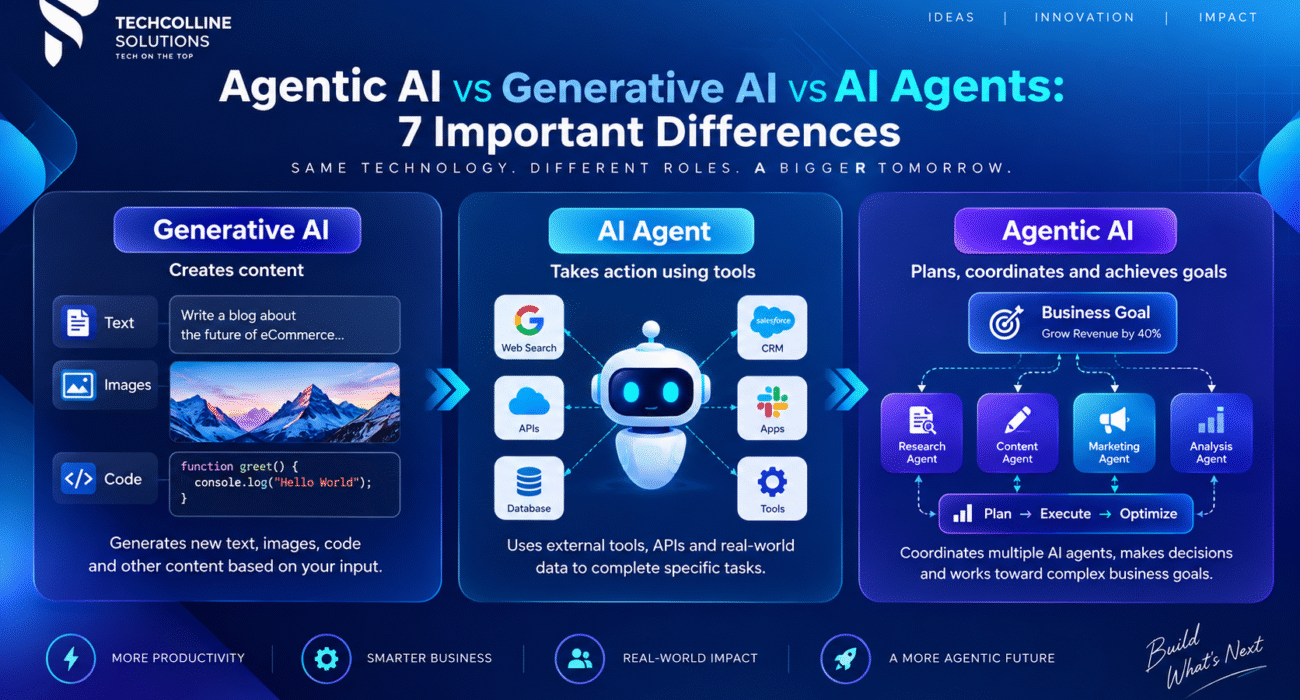
- Generative AI creates content and responses.
- AI Agents act by using AI, tools, and applications to complete tasks.
- Agentic AI describes systems designed to pursue goals through planning, decision-making, tool use, adaptation, and multi-step execution.
These categories can overlap. An AI Agent may use a Generative AI model internally, while Agentic AI can describe a broader architecture containing agents, tools, memory, workflows, and other software components.
Let’s break down what each means in simple language.
What Is Generative AI?
Generative AI is artificial intelligence that can create new content based on patterns learned from large amounts of data.
It can generate:
- Text
- Images
- Audio
- Video
- Software code
- Summaries
- Product descriptions
- Ideas and recommendations
For example, you could ask an AI tool:
“Write a product description for a waterproof backpack.”
The system generates the description.
That’s Generative AI.
Many Generative AI applications use large language models (LLMs). An LLM is an AI model trained on large amounts of text so it can understand and generate human-like language.
How does Generative AI work?
At a basic level:
You provide an instruction → the AI processes it → the AI generates an output.
For example:
Input: “Summarize this report.”
Output: A concise summary of the report.
Generative AI use cases
Businesses commonly use Generative AI for:
- Marketing content
- Customer-support responses
- Document summarization
- Product descriptions
- Coding assistance
- Translation
- Brainstorming
- Image generation
- Internal knowledge assistants
Generative AI can save significant time, but it isn’t automatically correct. It can produce hallucinations, meaning information that sounds convincing but is inaccurate.
Human review remains important when the output affects customers, finances, legal matters, healthcare, or other important decisions.
For businesses considering implementation, see Techcolline’s Generative AI development services.
What Is an AI Agent?
An AI Agent is a software system that uses AI to decide what actions to take to accomplish a defined task or goal.
This is where things become different.
Generative AI primarily produces an answer.
An AI Agent can potentially use that answer as part of a process and take action.
For example, imagine telling an AI:
“Find suitable laptops under ₹80,000 for our design team.”
A basic Generative AI system could recommend products based on information available to it.
An AI Agent connected to appropriate tools could:
- Understand the requirements.
- Search product information.
- Compare specifications.
- Filter products by budget.
- Prepare recommendations.
- Send the results to the purchasing team.
The exact capabilities depend on the tools, permissions, integrations, and rules built into the agent.
AI Agents vs Generative AI
A useful way to think about it is:
Generative AI = produces information.
AI Agent = uses AI to perform a task.
An agent may connect to:
- APIs
- Databases
- Search systems
- CRM software
- Business applications
- Internal company data
- Other software tools
For a deeper technical perspective, businesses can also refer to OpenAI’s practical guide to building AI agents.
Real-world AI Agent examples
Customer support agent
A support agent could retrieve an order, check its status, answer the customer, and create an escalation ticket when necessary.
E-commerce agent
An agent could search a product catalogue, compare products, check inventory, and recommend suitable products.
Internal business agent
An agent could classify incoming requests, retrieve company information, prepare responses, and route complicated cases to employees.
AI Agents therefore take AI beyond simple question-and-answer interactions and into task execution.
What Is Agentic AI?
Agentic AI refers to AI systems designed to pursue goals with a higher degree of autonomy.
Instead of simply responding to one instruction, an agentic system can potentially:
- Understand a goal
- Break the goal into smaller tasks
- Create a plan
- Make decisions
- Use tools and APIs
- Evaluate results
- Adjust its approach
- Maintain relevant context or memory
- Execute multiple steps
- Request human approval when necessary
The important word is goal.
Suppose a business says:
“Improve our customer retention.”
Generative AI might create customer emails.
An AI Agent might send approved emails to selected customers.
A broader Agentic AI system could potentially analyze customer information, identify opportunities, create a retention workflow, coordinate specialized agents, evaluate results, and adjust subsequent actions according to predefined rules and business controls.
This doesn’t mean agentic systems should operate without human supervision.
In fact, more autonomy requires stronger controls, especially when AI can access sensitive information or perform business-critical actions.
The terminology is still evolving across the industry, but this practical distinction is useful. IBM also describes agentic AI in terms of systems that can reason, plan, use tools, and take actions toward goals. See IBM’s overview of agentic AI.
Agentic AI vs Generative AI vs AI Agents: The Key Differences
| Feature | Generative AI | AI Agents | Agentic AI |
|---|---|---|---|
| Primary purpose | Create content or responses | Complete tasks | Pursue broader goals |
| Autonomy | Usually limited | Moderate, depending on design | Potentially higher |
| Content generation | Core capability | Often included | Usually included |
| Planning | Limited | Task-level planning | Central capability |
| Tool usage | Usually limited | Yes | Yes |
| Decision-making | Response-level | Task-level | Goal-oriented |
| Multi-step execution | Limited | Yes | Yes |
| Human involvement | Usually direct prompting | Often supervision/approval | Designed around appropriate oversight |
| Example | Generate an article | Check an order and create a ticket | Coordinate an entire customer-service workflow |
| Typical use | Content and information | Automation and task execution | Complex business processes |
The key point is that these aren’t necessarily three competing technologies.
Generative AI can be a component of an AI Agent, and AI Agents can be components of a broader Agentic AI system.
A Simple Real-World Example: Travel Planning
Travel planning provides an easy way to understand Agentic AI vs Generative AI vs AI Agents.
Generative AI
You ask:
“Create a five-day itinerary for Dubai.”
Generative AI creates an itinerary containing suggested attractions, activities, restaurants, and a daily schedule.
It creates the plan.
AI Agent
Now give the system access to suitable travel tools.
You ask:
“Plan my Dubai trip and find suitable hotels.”
The agent could:
- Understand your preferences and budget.
- Search available hotels.
- Compare options.
- Check relevant information.
- Present recommendations.
- Complete approved actions if the necessary booking integrations are available.
It performs tasks using tools.
Agentic AI System
Now give the system a broader goal:
“Plan my complete Dubai trip within my budget.”
A broader agentic system could coordinate itinerary planning, hotel research, attraction information, transportation options, scheduling, and other connected workflows.
It could evaluate results, revise the plan when requirements change, and request human approval before important actions such as payments or bookings.
This makes Agentic AI vs Generative AI vs AI Agents much easier to understand:
One creates. One acts. A broader agentic system can coordinate actions toward a goal.
For businesses interested in this particular application area, explore AI-powered trip planner app development.
Use Cases of Generative AI, AI Agents, and Agentic AI
The technologies can be applied across many industries.
- Healthcare: Generate summaries, assist with administrative tasks, and coordinate selected operational workflows with appropriate safeguards.
- E-commerce: Generate product content, answer customer questions, manage order-related tasks, and automate parts of customer service.
- Finance: Summarize documents, assist analysts, retrieve information, and automate controlled operational workflows.
- Travel: Generate itineraries, research travel options, coordinate planning, and assist with bookings.
- Marketing: Generate campaigns, execute repetitive marketing tasks, monitor performance, and coordinate workflows.
- Software development: Generate code, investigate issues, run tools, test changes, and coordinate development tasks.
- Education: Generate learning materials, act as a study assistant, and support personalized learning workflows.
- Logistics: Assist with planning, process operational information, and automate selected exception-handling tasks.
- Real estate: Generate property content, answer questions, retrieve listings, and assist with lead management.
The more a problem requires planning, external actions, multiple steps, and decisions, the more an agent-based approach may become useful.
Benefits
Generative AI
- Faster content creation
- Faster summarization
- Coding assistance
- Personalized content
- Increased employee productivity
AI Agents
- Automation of repetitive tasks
- Integration with business systems
- Faster task execution
- Reduced manual work
- 24/7 task handling
Agentic AI
- Complex workflow automation
- Coordination across multiple tools
- Goal-oriented execution
- Potentially more adaptive workflows
- Better coordination between humans and AI
However, these benefits depend heavily on good data, reliable integrations, appropriate instructions, testing, monitoring, and safeguards.
Drawbacks and Challenges
Greater AI capability also introduces greater responsibility.
Important challenges include:
- Hallucinations: AI can generate incorrect information.
- Incorrect actions: An agent capable of taking action can also take the wrong action.
- Security: Connecting AI to business systems creates additional security considerations.
- Privacy: Sensitive customer and business data must be protected.
- Cost: Models, infrastructure, APIs, monitoring, and integrations can increase operating costs.
- Reliability: Multi-step workflows can fail even when individual steps appear reasonable.
- Integration complexity: Connecting AI with existing software requires engineering effort.
- Compliance: Regulated industries may require additional controls and auditability.
- Excessive autonomy: Giving an AI system unnecessary permissions is poor system design.
The goal shouldn’t be to give AI maximum freedom.
The goal should be to give AI exactly the level of autonomy required to solve the problem safely and reliably.
Which One Should Your Business Choose?
Don’t start with:
“We need Agentic AI.”
Start with:
“What business problem are we trying to solve?”
Choose Generative AI when you need to create or transform information.
Examples:
- Marketing content
- Summaries
- Images
- Code
- Document analysis
Choose an AI Agent when you need AI to perform defined tasks.
Examples:
- Customer support
- Lead qualification
- Order processing
- Research
- Internal IT assistance
Consider Agentic AI when you have a complex goal involving multiple steps, decisions, tools, and workflows.
Examples:
- End-to-end business process automation
- Complex research
- Coordinated customer operations
- Software-development workflows
- Enterprise process orchestration
And there is an important point businesses often overlook:
Not every AI problem needs an AI Agent.
If a conventional software workflow, API integration, search system, or database query can solve the problem more reliably, use it.
AI should solve a business problem—not exist simply because the technology is fashionable.
For a broader implementation perspective, see Techcolline’s AI app development guide.
The Future of Generative AI, AI Agents, and Agentic AI
The future is unlikely to be about choosing one technology and abandoning the others.
Instead, these technologies will increasingly work together.
We can expect continued development around:
- More autonomous workflows
- Multi-agent systems
- Better tool and API integration
- Improved reasoning and reliability
- AI-powered business processes
- Industry-specific AI systems
- Human-AI collaboration
- Stronger security and governance
- Better monitoring and evaluation
Agentic architectures can combine AI models, tools, memory, workflows, orchestration, and conventional software components.
For businesses, the opportunity isn’t simply “using AI.”
It is designing the right AI architecture for the problem.
Businesses exploring AI-powered web and mobile applications can also learn more through AI-powered development platforms for web and mobile apps.
Frequently Asked Questions
Is Agentic AI the same as Generative AI?
No. Generative AI primarily creates content or responses. Agentic AI describes systems designed to pursue goals through planning, decision-making, tool use, and multi-step execution.
What is the difference between an AI Agent and Agentic AI?
An AI Agent is an individual software system capable of taking actions toward a goal. Agentic AI is a broader term describing systems or architectures that exhibit goal-oriented and more autonomous behavior.
Can Generative AI become an AI Agent?
Yes. A Generative AI model can become part of an AI Agent when it is connected to tools, data, instructions, and mechanisms that allow the system to make decisions and take actions.
Are AI Agents fully autonomous?
Not necessarily. Some agents operate independently within defined boundaries, while others require human approval before important actions.
Which is better for businesses?
There is no universal winner. Generative AI is generally suitable for content and information tasks. AI Agents are useful for task execution. Agentic AI is more appropriate for complex, multi-step goals and workflows.
What are examples of Agentic AI?
Examples include systems that coordinate research, customer operations, software-development workflows, business processes, or multiple specialized agents working toward a larger objective.
What are the risks of AI Agents?
Major risks include hallucinations, incorrect actions, security vulnerabilities, privacy issues, excessive permissions, unreliable workflows, and insufficient human oversight.
Conclusion
Understanding Agentic AI vs Generative AI vs AI Agents becomes much easier when you focus on what each technology is designed to do.
Generative AI creates.
AI Agents act.
Agentic AI describes systems designed to pursue goals through planning, reasoning, decision-making, tool use, and adaptation.
They are not necessarily competing technologies. In many applications, they work together.
A business might use Generative AI to create and understand information, an AI Agent to perform specific tasks, and a broader Agentic AI architecture to coordinate a complex business objective.
The right technology isn’t determined by the latest AI buzzword.
It is determined by the problem you need to solve.
Build Smarter AI Applications With Techcolline
If your business is exploring Generative AI, AI Agents, Agentic AI, or AI-powered business automation, the right starting point is understanding your workflow, data, integrations, security requirements, and required level of autonomy.
Discuss your AI application idea with Techcolline.
Techcolline Solutions — Ahmedabad, India
Email: info@techcolline.com
Website: Techcolline Solutions