
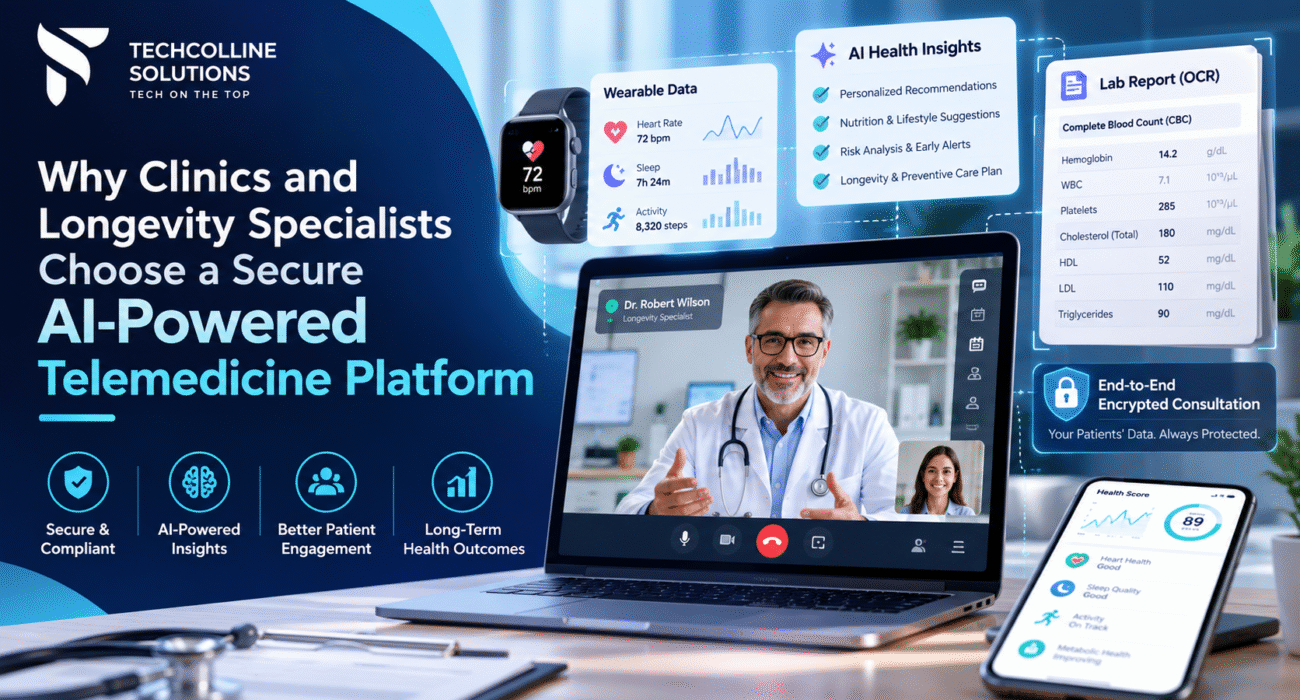
Patients now expect to see a doctor from their phone, sync data from their smartwatch, and get their lab results explained in plain language, not after a week of waiting. Clinics that run video calls on one tool, patient records on another and blood reports in a third are feeling the strain.
That is why AI-powered telemedicine platform development has moved from “nice to have” to a core business decision for clinics, health-tech founders and digital health startups. Research firm Towards Healthcare estimates the telehealth market at about USD 191.88 billion in 2026, growing to roughly USD 1.4 trillion by 2035. Forecasts differ between analysts, but they all point the same way: virtual care is becoming the default front door to healthcare.
In this guide to AI-powered telemedicine platform development, we break down what a modern telemedicine and EMR platform needs, which features actually matter, how security and compliance fit in, and how we at Techcolline Solutions built exactly this kind of platform for a live healthcare client, Endoage.
Quick answer: AI-powered telemedicine platform development produces a single system that combines encrypted video visits, patient records, scheduling, wearable data and AI that drafts reports and reads lab results. A custom build lets you fit your own clinical workflow, own your data and add integrations without per-seat licence limits. The core modules are encrypted one-to-one video, patient and doctor portals, an EMR, wearable integrations, AI report generation and OCR-based blood report analysis.
Why AI-Powered Telemedicine Is Growing So Fast in 2026
Three forces are pushing healthcare providers toward AI telemedicine platforms at the same time.
- Patients want convenience and continuity. A video visit that already knows their history, their latest labs and their recent activity feels like care. A visit that starts from zero feels like a call centre.
- Wearables have gone mainstream. Smart rings, fitness bands, continuous glucose monitors and connected scales now generate daily health data. Without a platform to collect and interpret it, that data never reaches the doctor.
- Doctors are short on time. Reading lab PDFs, typing notes and assembling reports eats into consultation time. AI can do the first draft of that work so the clinician can focus on the decision.
According to the World Health Organization, digital health tools are a key part of strengthening health systems and widening access to care. The providers who build on that foundation now are the ones who will own the patient relationship later.
Telemedicine vs EMR: Why You Need Both in One Platform
The two terms often get mixed up, so here is the short version.
- Telemedicine is how care is delivered remotely: video and audio consultations, messaging, remote monitoring and e-prescriptions.
- An EMR (electronic medical record) is where the clinical story lives: history, questionnaires, notes, prescriptions, lab results and follow-ups.
When these live in separate tools, doctors re-type information, miss context and juggle logins, and every extra tool is another place patient data can leak. When they live in one custom telemedicine software platform, the doctor opens a consultation and already sees the intake answers, the wearable trends and the latest blood report on a single screen.
Interoperability still matters. If you plan to connect with hospitals, labs or other systems later, build on open standards such as HL7 FHIR from day one, so you are not locked in when your needs grow.
Must-Have Features in AI-Powered Telemedicine Platform Development
Here are the features we recommend planning for in AI-powered telemedicine platform development, whether you start from custom EMR software development or a telemedicine-first build.
1. One-to-one encrypted video consultations
Video is the heart of any telemedicine app, and it has to be both reliable and private. A well-built consultation module includes:
- Encrypted one-to-one video and audio calls
- Session-based access control, so only the booked patient and doctor can join
- A virtual waiting room and a simple join-call flow
- Consultation completion tracking, so records and billing stay accurate
We typically build this on a proven real-time engine such as Agora, which handles call quality across weak mobile networks while we handle access control and data protection around it.
2. Multi-wearable integration and remote patient monitoring
A single wearable is a good start. A platform that supports several is far more useful, because patients use different devices. Integrations can bring in daily activity, sleep, heart rate and glucose data from popular devices such as Oura Ring, Whoop, Withings and Dexcom, so the doctor sees real-life trends between visits instead of a snapshot taken in the clinic.
The key design decision is to build a flexible data layer, so adding the next device is a configuration task rather than a rebuild.
3. AI-generated medical and wearable reports
Raw data is not insight. AI-powered report generation takes consultation inputs and wearable data and turns them into structured, readable reports for both the doctor and the patient. The doctor reviews, edits and approves, and the patient receives a clear summary in plain language.
This “AI assists, the clinician decides” model saves time without removing human judgement, and it is the right approach for any platform handling real patients.
4. Blood report analysis with OCR and AI
Lab results usually arrive as PDFs or photos. OCR (optical character recognition) reads those documents and pulls out the values automatically, and AI then organises them, flags what needs attention and feeds them into the patient’s record. That means:
- No manual typing of lab values
- Fewer transcription errors
- Faster turnaround from upload to doctor review
Accuracy matters here, so a good build includes validation checks and keeps the doctor in the loop before anything reaches the patient.
5. Smart scheduling, reminders and e-prescriptions
Slot-based booking, timezone-aware scheduling, rescheduling and cancellation handling, Google Calendar sync and automated reminders cut no-shows and admin work. Add digital prescriptions, consultation notes and follow-up scheduling and the doctor can close the loop inside the same platform.
6. Patient dashboard, doctor dashboard and admin panel
Each user group needs its own view. Patients want their appointments, history and prescriptions. Doctors want their calendar, assigned patients and reports. Administrators want users, pricing, payments and system monitoring. Role-based access control keeps each group seeing only what they should.
Case Study: Endoage and AI-Powered Telemedicine Platform Development in Action
Endoage is a doctor-led preventive health platform that connects patients with doctors online. The team behind it needed one place where intake, consultations, lab results and wearable data come together, and where AI reduces the paperwork instead of adding to it.
The challenge: build a platform from scratch that feels simple for patients, gives doctors the full picture in one view, and keeps sensitive health data secure.
What we built:
- A step-by-step patient onboarding and medical questionnaire with safety screening
- Patient and doctor portals with appointment booking, consultation history and prescription access
- Private, encrypted one-to-one video consultations
- Integration with multiple wearable devices, so daily health data flows in automatically
- AI-generated medical reports and wearable reports for doctors and patients
- Blood report analysis using OCR and AI, which reads uploaded lab reports and extracts the values
- An admin panel for managing users, programs, pricing and payments
The result: Endoage is live at endoagehealth.com, giving patients and doctors a single connected experience from first questionnaire to follow-up.
Projects like this reinforced three principles we now apply to every healthcare build:
- Start from the clinical workflow, not the feature list. Map how the doctor actually works, then design the screens.
- Keep AI assistive. Every AI-generated report is reviewed by a qualified clinician.
- Plan for more integrations. Wearables and lab formats change constantly, so the data model must be ready for the next one.
Security and Compliance: What Your Platform Must Get Right
Health data is among the most sensitive data there is, so security cannot be an add-on. A production-ready platform should include:
- Encryption of data in transit and at rest
- Role-based access control and secure authentication
- Audit logging and automatic session timeouts
- Explicit patient consent and data minimisation
- Secure handling of uploaded medical files
Which rules apply depends on where your patients are:
- United States: HIPAA governs how protected health information is stored and shared, and vendors that touch that data typically need a Business Associate Agreement.
- European Union: the GDPR treats health data as a special category that requires a clear legal basis and explicit consent.
- AI features: if your AI supports diagnosis or treatment decisions, it may be regulated as medical-device software. The FDA’s guidance on AI and machine learning in software as a medical device is a good starting point.
Raise compliance in your first planning call, not after launch. It shapes hosting, vendor choices and data design.
Custom Telemedicine Software vs Off-the-Shelf: Which Should You Choose?
Off-the-shelf telehealth tools get you live quickly, but they come with limits. Here is how the two approaches compare.
| Factor | Off-the-shelf telehealth tool | Custom AI telemedicine platform |
|---|---|---|
| Workflow fit | You adapt to the tool | The tool adapts to your clinic |
| Data ownership | Held on the vendor’s terms | You own the data and the roadmap |
| AI features | Generic or add-on | Built around your reports and lab formats |
| Wearable and lab integrations | Limited list | Any device or format you choose |
| Branding and patient experience | Vendor-branded | Fully yours |
| Long-term cost | Recurring per-user fees | Higher upfront, more control later |
What affects the cost of AI-powered telemedicine platform development?
We do not believe in quoting a number before understanding your project, because published ranges vary widely. The main cost drivers are:
- The number of modules (video, EMR, scheduling, payments, admin)
- How many wearable, lab and calendar integrations you need
- The depth of AI features, such as report generation and OCR
- Compliance requirements for your target regions
- Platforms: web, iOS, Android, or all three
- Ongoing support and improvements after launch
A phased approach keeps risk low: launch the core portals, scheduling and video first, then layer in integrations and AI. That is how we approached Endoage.
Why Choose Techcolline for Telemedicine and EMR Development?
Techcolline Solutions is a telemedicine app development company and technology partner that builds web and mobile apps for businesses that need dependable software, including AI-powered telemedicine platform development, and our healthcare work is proven by a live platform, not a slide deck. With us you get:
- Hands-on experience building AI telemedicine, wearable and OCR features
- Cross-platform expertise, including Flutter for iOS and Android
- Secure-by-design architecture and clear communication throughout
- A phased plan that gets you to launch without overbuilding
Browse more insights on our blog or see how we work on our About page.
Frequently Asked Questions
What is AI-powered telemedicine platform development?
It is the process of building a software platform that lets doctors and patients meet through secure video, while AI helps with tasks such as generating reports, reading lab results and summarising wearable data. It usually includes an EMR, scheduling, prescriptions and patient and doctor dashboards.
How much does custom telemedicine software development cost?
The cost depends on your scope: the modules you need, the integrations, the AI features, the compliance requirements and the platforms you want to launch on. Share your requirements and we will prepare a tailored estimate.
How long does AI-powered telemedicine platform development take?
It depends on scope. We usually plan a focused first phase (portals, scheduling and video) and then add integrations and AI features in later phases, so you can go live sooner and grow from there.
Is telemedicine software HIPAA and GDPR compliant?
Compliance depends on how the software is designed, hosted and operated. A platform can be built to meet HIPAA, GDPR or both, but it needs encryption, access control, audit logs and the right agreements with vendors from the start.
Can a telemedicine platform integrate wearables and lab reports?
Yes. Platforms can connect to wearables such as Oura Ring, Whoop, Withings and Dexcom, and can use OCR and AI to read uploaded blood reports and add the values to the patient’s record.
Will AI replace doctors on a telemedicine platform?
No. AI drafts reports, extracts data and highlights trends, but a qualified clinician reviews the results and makes the decisions. The goal is to give doctors more time with patients, not less.
Can you build the mobile app as well as the web platform?
Yes. Techcolline builds cross-platform mobile apps for iOS and Android alongside web platforms, so patients and doctors can use the service on any device.
Ready to Build Your AI-Powered Telemedicine Platform?
Whether you are a clinic going digital or a founder launching a new health-tech product, the right AI-powered telemedicine platform development partner makes the difference between a tool people tolerate and one they rely on.
Tell us about your project. Email us at info@techcolline.com or get in touch through our website, and our team will help you scope the right first phase.