
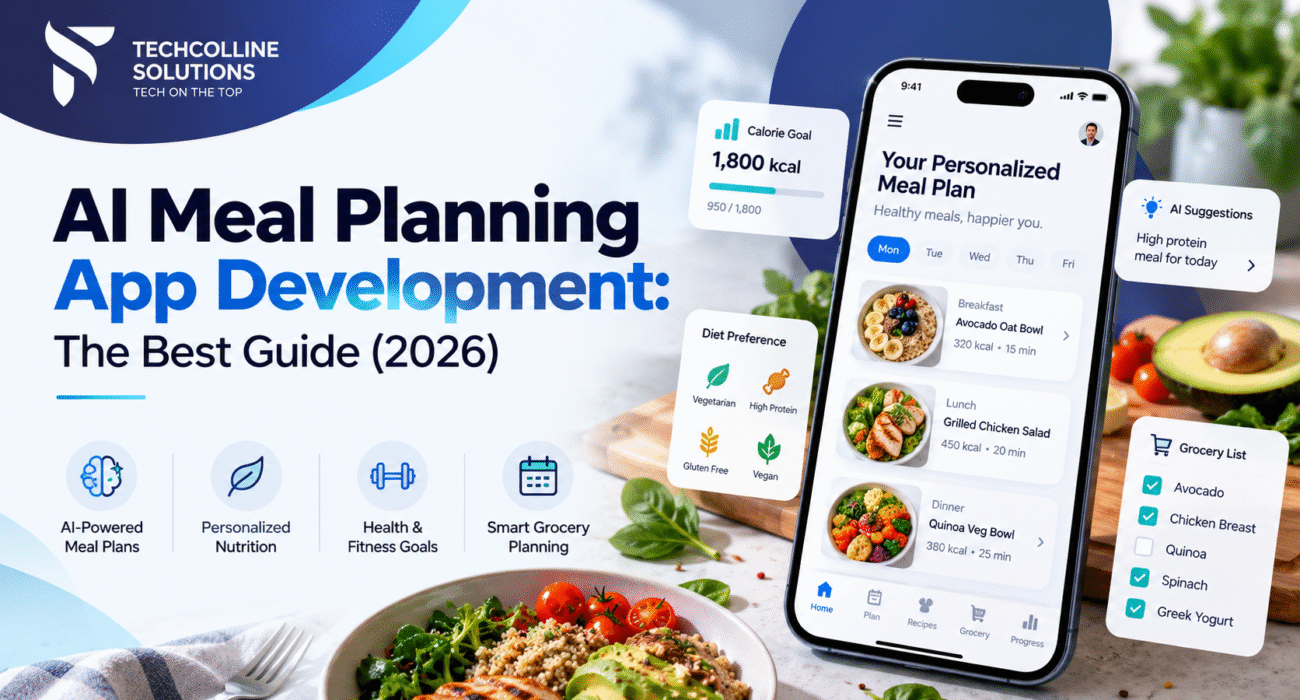
People want to eat better but don’t have time to plan every meal, count every calorie and write every grocery list. AI meal planner apps solve that, and demand is growing fast. According to The Business Research Company, the AI-driven meal planning app market is expected to grow from $0.67 billion in 2024 to $0.83 billion in 2025, and reach $2.00 billion by 2029 (a 24.9% CAGR).
If you are a startup founder, a dietitian platform, a fitness brand or a grocery business, this guide explains AI meal planning app development from start to finish: the features users expect, how the AI works, the right tech stack, how much it costs and how to monetize it.
What Is an AI Meal Planning App?
An AI meal planning app creates personalized meal plans based on a user’s goals, dietary preferences, allergies, budget and schedule. It then turns those plans into recipes, grocery lists and nutrition tracking, and adapts over time as the user logs meals and progress.
The “AI” part does three jobs:
- Personalization: builds plans that fit calorie and macro targets, diet types and taste preferences
- Recognition: identifies food from photos or barcodes to log meals in seconds
- Adaptation: adjusts future plans based on what users actually eat, skip and rate
Who Invests in AI Meal Planning App Development?
- Health and fitness startups launching a consumer nutrition app
- Dietitians and nutrition coaches who want to scale personalized plans to hundreds of clients
- Gyms and fitness brands adding nutrition to their workout apps
- Grocery and meal-kit businesses turning meal plans into shopping carts
- Healthcare and corporate wellness providers supporting condition-specific diets
Why Invest in AI Meal Planning App Development Now?
Consumers expect personalization, and generic calorie counters no longer keep users engaged. LLMs and on-device food recognition have become affordable, so features that once needed a large research team are now practical for startups. Wearables also supply real-time activity data that makes plans more accurate.
Together, these shifts make AI meal planning app development one of the most promising opportunities in health tech. Businesses that launch now can win loyal users before the category matures.
Must-Have Features in AI Meal Planning App Development
| Feature | What it does |
|---|---|
| Smart onboarding | Captures goals, body stats, diet type, allergies and cooking time |
| AI meal plan generator | Creates daily or weekly plans that hit calorie and macro targets |
| Recipe recommendations | Suggests recipes by taste, ingredients on hand and prep time |
| Photo calorie tracking | Estimates calories and macros from a meal photo |
| Barcode scanner | Logs packaged foods instantly |
| Automatic grocery list | Combines ingredients across the week, grouped by store aisle |
| Diet and allergy filters | Vegan, keto, gluten-free, diabetic-friendly, halal, Jain and more |
| Progress dashboard | Daily intake, weight trends and goal streaks |
| Wearable sync | Adjusts plans using Apple Health, Google Fit or Fitbit activity data |
| Reminders and nudges | Meal, water and grocery reminders that improve retention |
Advanced features that set an app apart: an AI nutrition chat assistant, pantry-based “cook with what I have” suggestions, family meal planning, dietitian dashboards, and grocery delivery integration.
How the AI in a Meal Planning App Works
- Nutrition targets: the app calculates daily calories and macros from the user’s profile and goal, using standard formulas such as Mifflin-St Jeor.
- Recipe filtering: recipes that break the user’s diet type, allergies or time limit are removed.
- Plan optimization: an optimization algorithm selects a combination of recipes that hits calorie and macro targets across the week while reusing ingredients to reduce cost and food waste.
- LLM layer: a large language model (such as GPT or Gemini) handles natural requests like “high-protein vegetarian dinners under 20 minutes”, swaps meals on request, and explains choices in plain language.
- Computer vision: an image recognition model identifies food in photos and estimates portions for calorie logging.
- Learning loop: ratings, skipped meals and logged food feed back into recommendations, so plans improve every week.
Reliable nutrition data is essential in AI meal planning app development. Instead of letting the AI guess nutrient values, connect verified databases such as USDA FoodData Central, Edamam or Nutritionix.
Useful documentation: USDA FoodData Central, Edamam Nutrition API, Nutritionix API, Apple HealthKit, Android Health Connect and Flutter.
Recommended Tech Stack for AI Meal Planning App Development
| Layer | Recommended options |
|---|---|
| Mobile app | Flutter (iOS and Android from one codebase) |
| Backend | Firebase Cloud Functions, Node.js or Python (FastAPI) |
| Database | Firestore or PostgreSQL |
| AI and LLM | OpenAI or Google Gemini APIs |
| Food recognition | TensorFlow Lite on-device models, or cloud vision APIs |
| Nutrition data | USDA FoodData Central, Edamam, Nutritionix |
| Health integrations | Apple HealthKit, Google Health Connect |
| Payments | RevenueCat with App Store and Google Play billing |
| Cloud | Google Cloud, AWS or Firebase |
Flutter is our first choice for AI meal planning app development: one codebase, smooth dashboards and charts, and strong support for camera, barcode scanning and health integrations.
Step-by-Step AI Meal Planning App Development Process
- Discovery and scope: define your audience, core features for the MVP and your monetization model.
- UX/UI design: fast onboarding, a clear weekly plan view and a one-tap grocery list.
- Nutrition and AI architecture: choose data sources, the plan optimization logic and the LLM prompts.
- Flutter development: build the app, backend and admin panel in agile sprints.
- AI and integration work: food recognition, wearables, payments and grocery partners.
- Testing: check calorie estimation accuracy, plan quality and performance on real devices.
- Launch: App Store and Google Play release with analytics set up.
- Growth and support: new diet filters, features and model improvements based on user data.
How Much Does AI Meal Planning App Development Cost?
| App tier | What’s included | Estimated cost (USD) | Timeline |
|---|---|---|---|
| MVP | Onboarding, AI meal plans, recipes, grocery list, basic tracking | $2,500 – $4,000 | 8–12 weeks |
| Mid-level | MVP + photo calorie tracking, barcode scanner, wearable sync, subscriptions | $4,000 – $8,000 | 3–5 months |
| Advanced | Mid-level + AI nutrition chat, dietitian dashboard, grocery delivery, custom ML models | $8,000 – $20,000+ | 5–8 months |
The main AI meal planning app development cost drivers are the number of AI features, the nutrition database licence, custom versus off-the-shelf food recognition, and third-party integrations. Budget separately for monthly API and hosting costs.
Privacy and Compliance
Meal and health data is sensitive, so privacy must be part of AI meal planning app development from day one. Encrypt data in transit and at rest, collect only what the app needs, and get clear consent. Depending on your market, plan for GDPR (EU), HIPAA (if you handle protected health data in the US) and India’s DPDP Act. Include a clear disclaimer that the app does not replace medical advice.
How to Monetize an AI Meal Planner App
- Subscriptions: free basic plans, paid premium tiers for advanced tracking and AI features
- Dietitian and coach plans: B2B licences for professionals managing many clients
- Grocery affiliates: commissions on grocery orders created from meal plans
- Meal-kit partnerships: order ingredients for the week in one tap
- Corporate wellness: sell employee nutrition programs to companies
Why Choose TechColline for AI Meal Planning App Development
- Flutter experts: high-performance iOS and Android apps from one codebase
- AI integration experience: LLMs, recommendation logic and image recognition
- Health and fitness app experience: we have built fitness and wellness apps with activity tracking and rewards
- End-to-end delivery: strategy, design, development, launch and ongoing support
- Trusted by clients: rated 4.9/5 on Clutch, working with clients in the US, Europe and India
Frequently Asked Questions
How long does it take to build an AI meal planner app?
An MVP typically takes 8–12 weeks. A full-featured app with photo tracking, wearables and subscriptions takes 3–8 months.
Is Flutter good for AI meal planning app development?
Yes. Flutter delivers native-quality performance on iOS and Android from one codebase, and supports camera, barcode, charts and health integrations well.
Can I use ChatGPT or Gemini to power my meal planning app?
Yes, for natural-language requests and explanations. For accuracy, pair the LLM with a verified nutrition database and a plan optimization layer instead of letting it calculate nutrition on its own.
How does an AI meal planner calculate calories?
It estimates the user’s daily needs from age, weight, height, activity and goal, then totals recipe nutrients from a verified food database. Photo tracking uses image recognition to estimate portions.
How much does AI meal planning app development cost?
Most projects range from $4,000 for an MVP to $20,000+ for an advanced app, depending on features and integrations.
Get a Free Estimate for Your AI Meal Planner App
Demand for AI meal planning app development is growing fast, and users are ready for apps that remove the effort from healthy eating. With the right features and a solid AI architecture, your app can become a daily habit for your users.
Ready to build your AI meal planning app? Book a free consultation and get a detailed estimate within 48 hours.
- Phone / WhatsApp: +91 81413 29138
- Email: info@techcolline.com
Related reading: AI trip planner app development guide · Generative AI development services